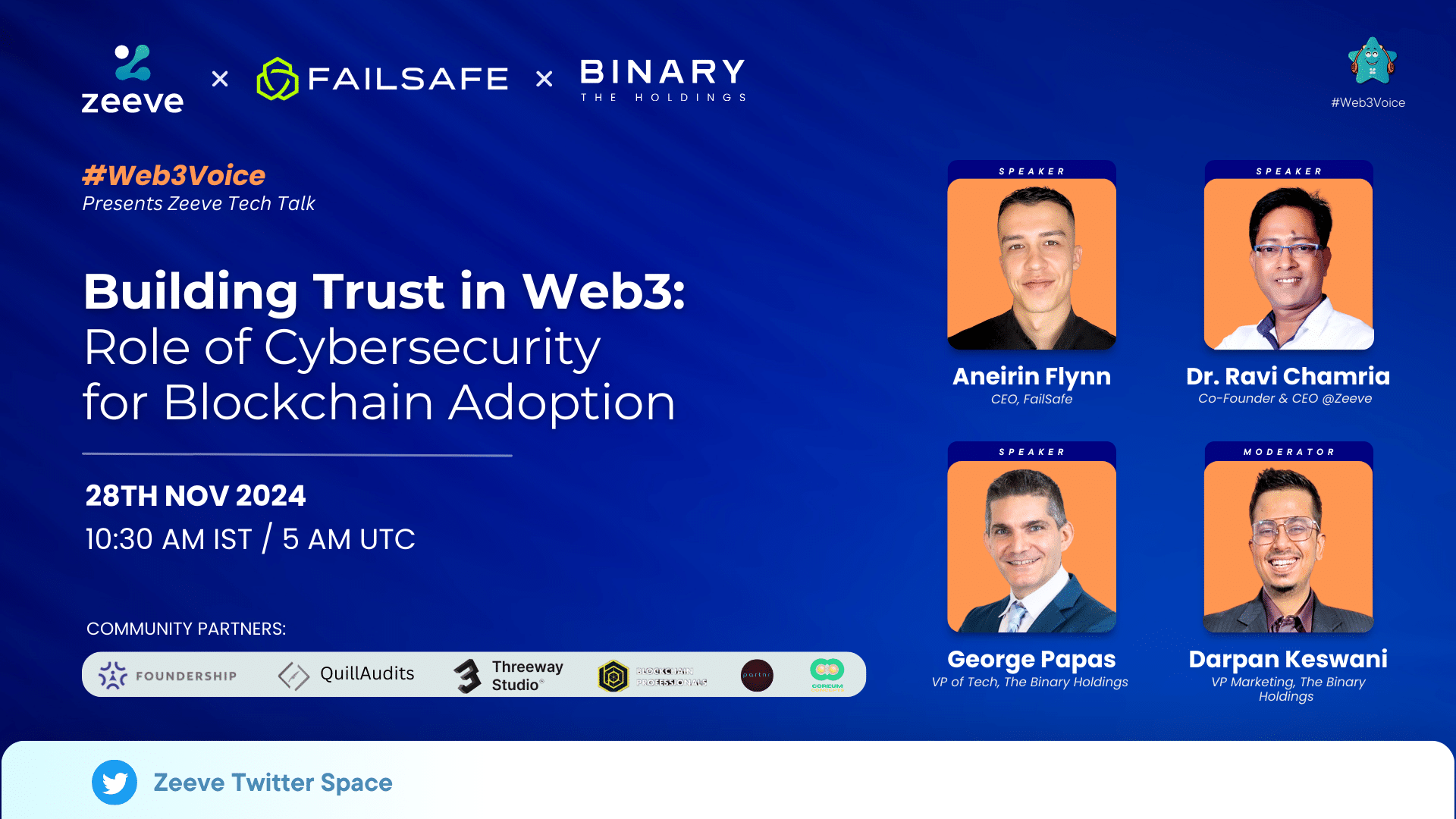
“You wouldn’t walk down a dark alley with a fat wallet” – this analogy from Failsafe’s CEO perfectly captures why security remains blockchain’s biggest challenge. In a packed Twitter Space hosted by Binary Holdings on November 28th, industry leaders showed how they’re flipping Web3 security from individual responsibility to platform-level protection, similar to how Google Chrome protects users without them even knowing it.
The discussion brought fresh perspectives on how Web3 security is evolving beyond basic audits and wallet warnings. Imagine your crypto wallet knowing you’re usually asleep at 3 AM and automatically blocking suspicious transactions during those hours – that’s the kind of intelligent protection being built right now.
Catch the full conversation here:
https://twitter.com/i/spaces/1vAxROyebZqKl
Key Takeaways:
- Security is moving from “user beware” to “platform protect” – systems now automatically detect and block suspicious activities.
- AI-powered monitoring is becoming the new standard, with systems learning to spot fraud patterns before they succeed.
- Layer 2 networks are particularly vulnerable to bridge exploits – making secure bridging crucial for mass adoption.
- Enterprise adoption hinges on matching traditional security standards – from HIPAA compliance to advanced API protection.
- Cross-chain security is the next frontier, with solutions being built to validate transactions across multiple chains simultaneously.
The partnership between Failsafe x Zeeve x Binary Holdings shows how Web3 security is maturing. Zeeve, with its enterprise-grade infrastructure (ISO 27001 and SOC 2 Type 2 compliant), provides the secure foundation for Binary Holdings’ OP Stack rollup chain. On top of this, Failsafe, available as an integration on Zeeve, adds its intelligent monitoring system, creating comprehensive protection for millions of Binary’s telecom users.
The real innovation comes in how these solutions work together. Binary Holdings’ CTO, George Papas, broke down their integrated approach: robust API security, rate limiting, and a zero-trust architecture using microservices. Combined with Failsafe’s monitoring system, on top of Zeeve, The Binary Holdings creates protection that works silently in the background.
“Enterprises do have a very sound information security in place. When they extend their application stack from Web2 to Web3, they would like to have the same kind of security comfort, said Dr Ravi Chamria, co-founder and CEO of Zeeve.
Instead of expecting users to be security experts, the system should watch for suspicious activities automatically. Flynn from failSafe illustrated this with a simple example:
“Because I am typically asleep during the hours of midnight and 6:00 a.m., I shouldn’t be expecting to interact with any smart contract. If funds are moving from a Binary wallet at that particular time, that transaction just gets paused, and you get a notification.”
This intelligent protection works silently in the background, just like modern banking security. For modular blockchains, security can take a different turn with sequencer decentralization. Zeeve is working on it with Cero.
“Sequencer centralization is another area that we at Zeeve are focusing on. We are launching our own decentralized sequencers, initially for ZK rollups, but then we’ll extend to optimistic roll-ups as well.”.
Looking ahead, Binary Holdings is already working on their next frontier: cross-chain security.
“I look forward to collaborating with partners like Zeeve and Failsafe as we ensure more security protocols. This way, we can enable a smoother adoption for enterprises who are hesitant about blockchains due to security concerns,” Papas shared.
If you’re also a web2 enterprise still thinking how you could integrate Web3, get in touch with us. Our experts will assess your requirements and suggest the best stack and integrations for your industry and application.