“You can pay once and store your files long-term, but with Arweave it was quite expensive. Looking back, I was thinking – will I use this? Is the cost worth it?”
- Nandit Mehra, Founder LightHouse
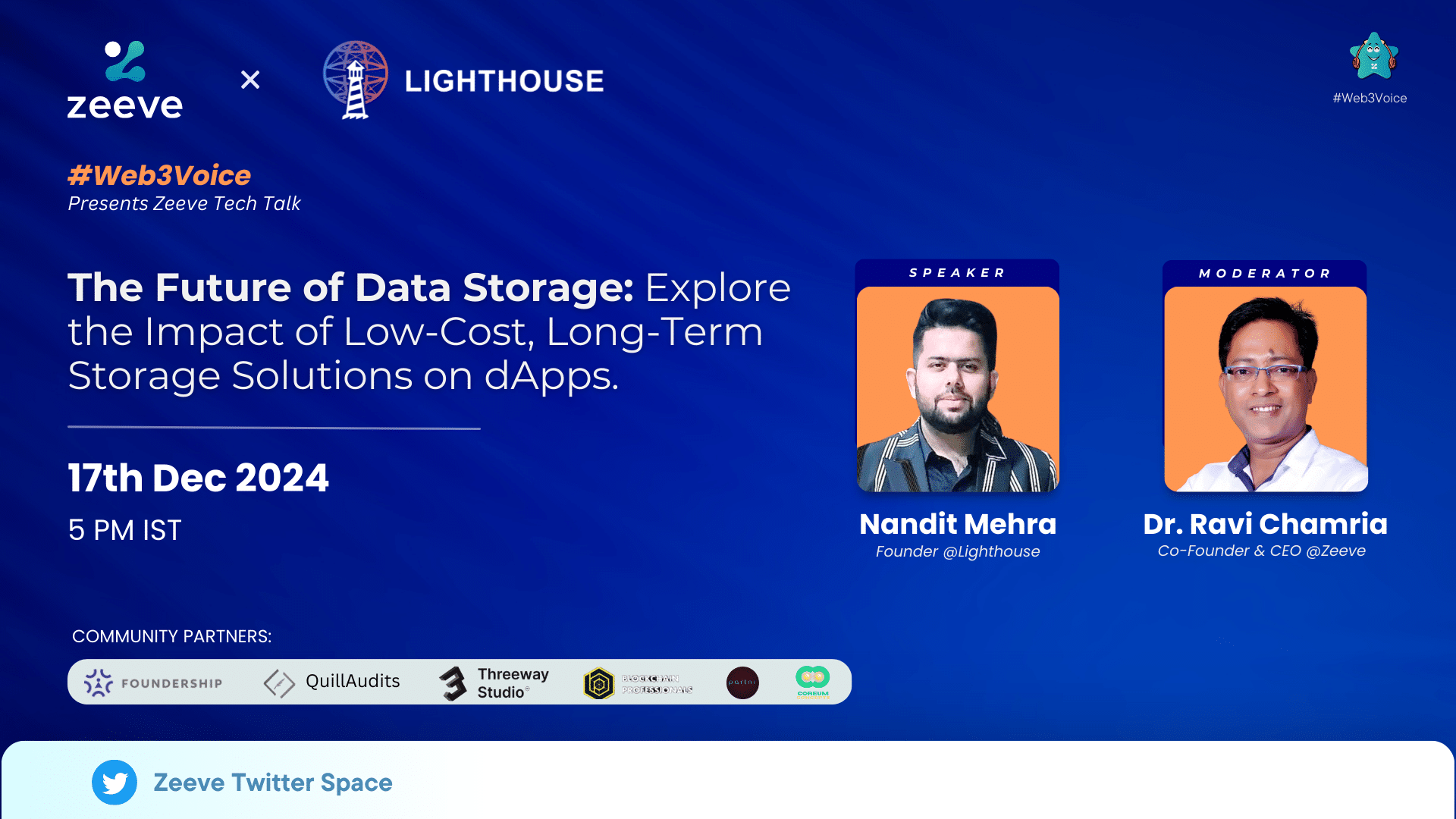
Data has a cost crisis in Web3, still. With Solana’s chain data alone crossing 450 terabytes, storage costs are becoming unsustainable. But what if you could pay once and store forever? During Zeeve’s December 17th Twitter Space, Lighthouse founder Nandit Mehra shared how they’re making this possible by turning traditional storage economics upside down.
The discussion between Nandit and Dr. Ravi, CEO of Zeeve, talks about handling terabytes of data for major networks while keeping costs 1000x cheaper, specially for appchains and rollups.
Get the full session here:
https://x.com/i/spaces/1yoKMyzDDMoKQ
Key Takeaways:
- Lighthouse’s endowment pool generates sustainable yields through DeFi protocols, making permanent storage affordable
- Zeeve’s rollup platform integrates Lighthouse natively, enabling one-click storage setup during chain deployment
- Five-node distributed encryption of Lighthouse ensures enterprise-grade security while supporting both Web2 and Web3 authentications
- The setup offers Geographic data controls with strict compliance requirements for government and enterprise clients
- Emerging data DAOs will enable AI training monetization for stored content
At the heart of Lighthouse’s innovation is an endowment pool model. Similar to how universities maintain operations through centuries, smart contracts manage funds that generate yields through DeFi protocols, ensuring sustainable storage costs.
“When you pay for the data, it goes to this on-chain smart contract pool that we call an endowment pool, like how universities and museums work. There’s an endowment pool model where people would put in resources, and then that allows knowledge and data to persist over years and decades,” said Nandit Mehra, founder of LightHouse.
The integration with Zeeve’s Rollups-as-a-Service(RaaS) makes LightHouse tech accessible to developers and enterprises launching their own custom blockchains. Through Zeeve’s RaaS dashboard, teams can configure permanent storage during rollup deployment. This could significantly reduce setup complexity and their ongoing management.
The Security aspect is also well taken care of in LightHouse. The platform splits encryption keys across five nodes, yet keeps things simple for users. As Nandit puts it,
“You can authenticate using your Metamask, Google, GitHub, or just use Face ID – whatever works for you.”
Their adoption is top-notch, too. SingularityNET, one of Web3’s largest AI projects, has integrated Lighthouse in their backend. It’s so seamless that developers might not even realize they’re using it. They just work with a familiar Python SDK, while Lighthouse handles the heavy lifting of secure storage behind the scenes.
For enterprises and governments, data location matters more than ever with rising security & privacy laws. Lighthouse lets organizations choose exactly where their data lives – whether it’s India, Dubai, or Europe. When combined with Zeeve’s enterprise-grade RaaS infrastructure, this geographical control opens doors for large-scale adoption.
The teams are building towards data DAOs, also, that could turn stored content into revenue streams through AI training.
“We have storage, we have encryption, we have access control,” Nandit shared. “Now imagine all the NFT data being labeled and monetized via AI models – that’s where we’re headed.”
This partnership with Zeeve is about making Web3 infrastructure actually work for real applications.
“One-click deployment with permanent storage from day one – that’s what builders need.”
And Zeeve and LightHouse are enabling that.
Want to build with LightHouse storage? Connect with Zeeve’s experts to learn how you can deploy your rollup with enterprise-grade security and seamless Lighthouse integration.